

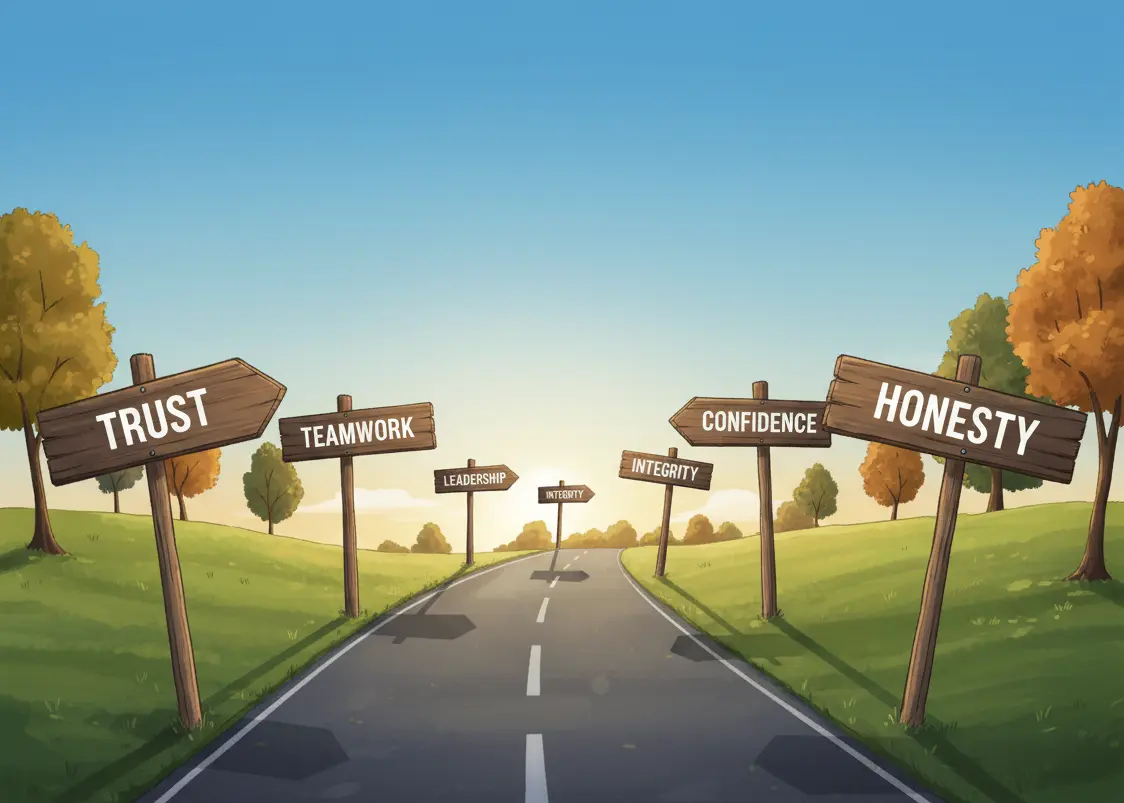
Reflection exercise – before you read on
Pause for a moment and honestly answer a few questions:
- What are the three most important values that you believe truly apply in your team or organization?
(Not those from a presentation — but those you observe in daily behaviors.) - How do you know these values are alive?
What specific behaviors demonstrate them? - When was the last time you consciously referred to them? In a conversation, feedback, decision, or team meeting?
- Does your team discuss values in a concrete way?
Do you define them through behaviors (e.g., “what respect means to us,” “what courage looks like in meetings”)? - If a new person were to join the team today — how would they know what values apply here?
From a document, observation, conversation with a leader… or rather from assumptions?
M: Let’s start with the basics. When we talk about organizational culture, the topic of values very often comes up. From your perspective as a leader, what does the real work with values in an organization look like — not at the level of declarations or slides, but in the daily functioning of a team?
A: Every organization should operate based on values that are above the operating system, above KPIs — something non-negotiable. For example, respect.
We agree to respect each other. Does everyone agree to this? Yes. But what does that actually mean? It means, among other things, that we do not undermine each other’s authority in front of others. Then, during meetings, these values are referenced.
In my last company, values were written on the wall — literally hanging above us during meetings. The entire organization operated based on these values. If a certain boundary was crossed, it was the leader’s role to refer to them: “Listen, we agreed to respect each other. There are certain limits — let’s not cross them.” If mutual support is an organizational value, then we support each other. If courage in speaking up is a value — we expect everyone to bravely voice their opinion in a meeting. These values are crucial because they are outside the operating system. They are not changed — they are defined and meant to function for years.
VALUES “ON THE WALL” AND THOSE “IN PRACTICE”
M: Yes. And most often in organizations I’ve been a part of, these values already exist. However, in 80–90% of cases, they are somewhere on the website and remain an abstraction. Sometimes someone remembers something, but they don’t live on a daily basis.
A: And here again, the crucial role of the leader emerges. The leader — as well as the head of HR — should be the guardians of these values. If a value is violated — it needs to be called out: “You are not acting in accordance with the values.” I’ll say more — in my last company, during semi-annual or annual reviews, there was always a reference to operating in accordance with values. If someone clearly violated them, it was taken into account in the evaluation. This also answers the question of whether you fit into the organization and if you want to work in accordance with these values.
M: What if you join an organization where values are written down, but in practice, an informal agreement and completely different values operate?
A: Then it’s time to talk to the management board about changing the values.
M: So, it takes courage to say: “I don’t see the values that are on the website. I see completely different ones.”
A: First, there should be reflection. If we observe that values are not respected, it needs to be stated clearly at the appropriate level. “You said respect is a value, but I see situations that contradict it.” I recently saw an article on LinkedIn about why people leave companies. Of course, it’s often about money, but if culture and values are respected, people are able to return to such an organization someday. If they are not — they will never return.
WHAT ARE YOUR MOST IMPORTANT VALUES?
M: So you assume a scenario where, even if the organization as a whole doesn’t fully embrace this, I can develop values and principles within my own team.
A: Always. For me, the most important values are respect and trust. If they function — trust emerges naturally. If I don’t receive these values from the organization, it means I am not fulfilled within it.
M: So, as a leader, you have clarity on which value is crucial for you and without which you cannot function. And if this doesn’t happen for several months, you start thinking about leaving.
A: Exactly. That’s why it’s so important for a leader to regularly emphasize these topics — in monthly, team meetings — and revisit them.
M: So you react not only when values are violated, but also when they are well implemented — you provide positive feedback.
A: Yes, then recognition emerges. This is more of an HR area: programs that reinforce values, appreciating people who act in accordance with them. If courage is a value — we reward reporting a problem. Someone has the courage to say that a process isn’t working and is generating losses — that requires inner strength. By rewarding such attitudes, we strengthen values. The same applies to respect — there are plenty of examples.
M: You also said it’s worth checking if all team members agree on these values — or that we create them together.
TEAM CONTRACTING – OUR AGREEMENT
A: If values are not imposed from above, the team should develop them. What’s more — there’s nothing to prevent a given team from operating according to its own set of values. It’s a gentleman’s agreement. We agree that everyone speaks up. If someone talks nonsense — someone from the team will call it out. It’s simple, but it’s an agreement.
M: And this is very much connected to conflict prevention. Today I led a workshop on conflict management and emphasized that prevention is key. One of its elements is a team agreement. Values here are like a flag — more abstract — but we also need very specific arrangements: responsiveness, cameras, communication methods. I recently had a team in conflict, and a new person from another location joined. For her, a lack of reaction to “Hey, what’s up?” was a lack of etiquette, while for the team, it was the norm. Only a joint meeting and establishing rules resolved the problem.
A: And this is precisely where the leader’s role lies. One must say: “This is a new person, we need to agree on the rules.” Check if they are acceptable to everyone. That is the essence.
M: What if the new person says: “That’s nonsense, you’re doing it wrong”?
A: Then the leader must step in. We learn from each other. If someone proposes a new practice — let’s listen. But the decision belongs to the team.
M: So sometimes you delegate the decision to the team, and sometimes you make decisions more directly.
A: Yes. Democracy works as long as the team doesn’t go down a blind alley. Leaders are often expected to set the direction. You can agree: “We’ll try. If it doesn’t work — we’ll change it.” Check and adjust.
M: And all of this fits very well with the topic of the first 90 days.
A: Exactly. The first 90 days are a time to establish values, a contract, and principles of cooperation. I know leaders who wrote them on the wall. I myself tended to establish unwritten rules — e.g., that I don’t regularly read emails and for urgent matters, one should call. This is also part of the contract.
M: And you give people the right to “reach out” to you.
A: Yes. There are also sacred rules — safety and health. For such matters, a 24/7 phone call. And this needs to be clearly established at the beginning.
M: Can rules be renegotiated?
A: Of course — we check if they work, and we adjust them if the situation requires it.
WORKING ON VALUES
M: I think working with these values can also be fun. When I conduct workshops on defining values or working on existing values, it’s an invitation to very valuable discussions. This is something that can truly pay off significantly at a later stage of decision-making. I recall an interview with Maciej Filipkowski — how beautifully he spoke about the values he established with his team when creating a podcast. These were great things, e.g., that it should be “fun” — isn’t that a wonderful value at work? — and that it should lead to a decent life. Or that others’ priorities are not our priorities, and how that works in practice. This requires continuous analysis. These values — as Filipkowski says — help you understand who you are, what kind of team you build, and what value you create for others.
Anita Michalska says in another interview that her business values are primarily time and peace of mind, and only then money. This determines what projects she undertakes and whether she undertakes them at all. And of course, it’s different when we are invited to co-create values, and different when we join an organization where values are already established and it’s our duty to consider them in our actions — but we still have the right to discuss them and define them together.