Coach and Leaders


Blog

  • It’s easier to hit bigger targets…

    It’s easier to hit bigger targets…

    M: How do you approach setting goals for yourself? In training sessions, it’s almost embarrassing to talk about SMART goals, because everyone knows the concept, but when it comes down to it, real-world application proves to be more challenging.

    A: One of the most important things for me regarding goals is the idea that it’s worth aiming higher than you want to achieve, and ultimately, bigger goals are easier to hit. This is my maxim. The truth, however, is also that sometimes a bigger goal is unattainable. And now—if you habitually set goals that are not achievable, first, we forget about SMART, and second, we demotivate the team and lower energy levels.

    There’s a movie about this—Whiplash. It tells the story of a student-mentor relationship at a music academy in the States. The music teacher pushes the boundaries of his protégés’ capabilities to an extreme degree to reach a level of genius. The problem is that this applies to one per mille of people in the world who actually achieve above-standard results through pressure and “pushing.” Most of us, however, are not that one in a thousand, and people are more likely to be destroyed this way.

    M: The costs of this process are enormous.

    A: I recommended this film to many of my leaders, especially those who came to me and said: “Aleksander, this is f… impossible. It can’t be done. These are goals that are unattainable in such a timeframe, with such resources.” I say: yes and no. However, watch this film. Sometimes, when you theoretically exceed your maximum capabilities, you achieve something extraordinary—and you also need to look at it from that perspective.

    M: So, realistic, but also ambitious? People need to feel progress, to see that things are moving forward, but at the same time, they must dare to do more. I remember a conversation with one of Google’s managers who said they deliberately set unattainable KPIs, because they found that by reaching for the impossible, people still achieved more than if they had planned rationally. So there isn’t one simple answer—you have to look at it from both sides.

    A: Less is more. That has always worked for me. Goals should be clearly defined, but there shouldn’t be more than five of them.

    Deming’s methodology assumes check and adjust. You have a plan, then there’s check and adjust. I very often use this in relation to goals. You define a strategy, form a hypothesis, and based on that, an action plan is created and implemented. But at some point, you have to say: “I’m checking.” The leader’s role is to define the plan and implement it, but also to check and adjust. During follow-up, you need to pause, refer to what you wanted to achieve, and ask one fundamental question: “Is it working or not?” If it’s working—continue. If not—engage adjust and update the goal.

    And this is precisely the difficult moment in working with goals. If you see that you are consistently 20% below assumptions, below target, and the trend in no way indicates that you can achieve it, it’s time to say: “OK, let’s do SMART and set this goal completely differently.” That’s why I listed it as a separate point—I would say: a milestone in the process—because it’s simply necessary.

    Changing Assumptions

    M: It’s not always easy to honestly admit that we need to change the assumptions of the original plan.

    A: Many leaders lose their power and authority when they blindly, with blinders on, pursue a goal that is unattainable. The team identifies this very quickly. The leader’s role is to be able to say: “OK, this can’t be done. We have to do it differently.” There’s a quote attributed to Einstein: “Insanity is doing the same thing over and over and expecting different results.”

    M: It also happens that you have to face goals that you don’t fully believe in yourself, but which have been set by the organization. For me, it would be inappropriate if I went to the team and said: “Listen, these goals are pointless and unrealistic, but management decided so, so we’re pushing through.” In my opinion, a leader cannot say something like that.

    A: Should not.

    M: It’s difficult and not black and white. Neither artificial enthusiasm nor sincere defeatism will work—both weaken morale. What if I have a goal I don’t identify with, but I have to “sell” it to the team and enforce it?

    A: Every goal is achievable—resources are key. The leader’s role is to define them in such a way that the goal becomes attainable. Resources can be time, knowledge, or people. The question is: how does the leader define resources for a goal that has been imposed on them?

    M: So assertiveness from the leader is also needed in “upward” communication — what is possible and what is not.

    A: Exactly. It’s a bit like being given a fire hose to put out a fire, but without the water turned on. In such situations, there’s nothing better than teamwork and collective brainstorming. Telling the team directly: “These are very difficult goals—stretch targets—both in terms of time and resources. Let’s think together about what we can do and what means we can use.” Then the plan isn’t created in one person’s head—everyone contributes something. The burden of the goal is distributed across the entire team. It often turns out that additional resources are needed, and then the organization redirects them.

    M: But you have to talk about it, you have to stop and analyze it. Strategic meetings and reflection are key here.

    A: And you have to be aware that if a goal is unattainable and there’s no indication it will succeed, a leader’s maturity lies in going to the client or principal and saying: “It can’t be done.” You can’t bury your head in the sand.

    M: Do you recall any stories where people didn’t dare to say this in time—or you had to communicate it?

    A: It happens constantly. In Poland, we tend to grit our teeth and, at our own expense, drive ourselves to very difficult health conditions, loss of authority, and weakened leadership.

    M: Do you communicate with your people to ensure they have the courage to come and say it? I feel that if we don’t agree on this, people—raised in a culture of “I’ll somehow deliver”—won’t say it directly. Especially if they have experience with other bosses where it didn’t pay off. One of the managers I work with comes to mind—he has a very dominant personality. If he didn’t keep telling me: “Martyna, I need you to challenge me sometimes and have the courage to disagree with me,” I’d probably do half as much.

    Taking Initiative in Goal Setting

    From a different perspective, based on your experience, to what extent should one take temporal and decision-making initiative in the context of goal setting, when theoretically they should be assigned from above?

    A: How it looks in terms of time and decisions results from various conditions related to HR systems and the calendar, which usually determines what should happen in the company and when. Namely: in the fourth quarter, employee self-assessment takes place, followed by the manager’s annual review, then a calibration meeting, and finally a feedback meeting with the employee. At the beginning of the year, the process of defining goals by the corporation opens and usually lasts several weeks.

    The result is that the system opens for goal definition at the end of February or beginning of March, which physically shortens the period for goal achievement to 9 months, meaning the first quarter is lost.

    M: If that’s indeed the case, what’s your approach to it, and how do you define goals?

    A: From my experience, there’s no point waiting for the organization, and often you have to take the initiative. I try to define goals already in December. In the first weeks of December, it’s already more or less clear what challenges the current year has brought and what needs to be focused on in the new, upcoming year. That’s why I sit down to work on goals in mid-December, and once I have a draft, I schedule a meeting with my Boss to discuss their perspective on expectations.

    Such a meeting concludes with a so-called Sign-off, and the goals are ready to be communicated.

    At the beginning of the new year, I communicate the goals for the entire organization to my team, most often in an Excel format that precisely and measurably defines what I care about in the new year.

    M: But shouldn’t your supervisor set your goals?

    A: Yes, theoretically, yes. However, for many years I’ve found that if you don’t take the initiative yourself, the process radically lengthens and isn’t effective enough. Often, organizations lack a global strategy that clearly defines priorities, and that’s when it’s worst. Therefore, instead of waiting for your Boss, it’s better to take the initiative and take the bull by the horns.

    In summary:

    1. Less is more – ensure the number of goals doesn’t get out of control and that everyone knows the top 5 most important ones.
    2. Deming in practicecheck & adjust as a mandatory ritual – not “someday”.
    3. Leader’s courage – to be able to say: “Yes, I want more… but not blindly.” And when necessary: “It can’t be done – we’re changing our approach” (quoting a classic: “Insanity is doing the same thing over and over and expecting different results”).
    4. Resources = feasibility – time, people, competencies. If the goal is imposed, I negotiate resources and transparently engage the team in joint brainstorming.
    5. Take initiative – don’t wait for the “system to open” in February/March.

    An exercise for reflection:

    1. Consider whether you are able, without looking at any documents, to write down your top five most important goals for the company right here and now?
    2. If you were to ask your leaders/managers about this, would they be able to write the same thing, or do you have unquestionable clarity here?
    3. How often do you check how unified and consistent the priorities are?
    4. How often during the year do you monitor with your team where you stand in relation to the initial assumptions, and is there time and space for Deming’s analysis and eventual correction of assumptions?
  • 04 – What is the importance of defining values for a company and a team?

    04 – What is the importance of defining values for a company and a team?

    Reflection exercise – before you read on

    Pause for a moment and honestly answer a few questions:

    1. What are the three most important values that you believe truly apply in your team or organization?
      (Not those from a presentation — but those you observe in daily behaviors.)
    2. How do you know these values are alive?
      What specific behaviors demonstrate them?
    3. When was the last time you consciously referred to them? In a conversation, feedback, decision, or team meeting?
    4. Does your team discuss values in a concrete way?
      Do you define them through behaviors (e.g., “what respect means to us,” “what courage looks like in meetings”)?
    5. If a new person were to join the team today — how would they know what values apply here?
      From a document, observation, conversation with a leader… or rather from assumptions?

    M: Let’s start with the basics. When we talk about organizational culture, the topic of values very often comes up. From your perspective as a leader, what does the real work with values in an organization look like — not at the level of declarations or slides, but in the daily functioning of a team?

    A: Every organization should operate based on values that are above the operating system, above KPIs — something non-negotiable. For example, respect.
    We agree to respect each other. Does everyone agree to this? Yes. But what does that actually mean? It means, among other things, that we do not undermine each other’s authority in front of others. Then, during meetings, these values are referenced.

    In my last company, values were written on the wall — literally hanging above us during meetings. The entire organization operated based on these values. If a certain boundary was crossed, it was the leader’s role to refer to them: “Listen, we agreed to respect each other. There are certain limits — let’s not cross them.” If mutual support is an organizational value, then we support each other. If courage in speaking up is a value — we expect everyone to bravely voice their opinion in a meeting. These values are crucial because they are outside the operating system. They are not changed — they are defined and meant to function for years.

    VALUES “ON THE WALL” AND THOSE “IN PRACTICE”

    M: Yes. And most often in organizations I’ve been a part of, these values already exist. However, in 80–90% of cases, they are somewhere on the website and remain an abstraction. Sometimes someone remembers something, but they don’t live on a daily basis.

    A: And here again, the crucial role of the leader emerges. The leader — as well as the head of HR — should be the guardians of these values. If a value is violated — it needs to be called out: “You are not acting in accordance with the values.” I’ll say more — in my last company, during semi-annual or annual reviews, there was always a reference to operating in accordance with values. If someone clearly violated them, it was taken into account in the evaluation. This also answers the question of whether you fit into the organization and if you want to work in accordance with these values.

    M: What if you join an organization where values are written down, but in practice, an informal agreement and completely different values operate?

    A: Then it’s time to talk to the management board about changing the values.

    M: So, it takes courage to say: “I don’t see the values that are on the website. I see completely different ones.”

    A: First, there should be reflection. If we observe that values are not respected, it needs to be stated clearly at the appropriate level. “You said respect is a value, but I see situations that contradict it.” I recently saw an article on LinkedIn about why people leave companies. Of course, it’s often about money, but if culture and values are respected, people are able to return to such an organization someday. If they are not — they will never return.

    WHAT ARE YOUR MOST IMPORTANT VALUES?

    M: So you assume a scenario where, even if the organization as a whole doesn’t fully embrace this, I can develop values and principles within my own team.

    A: Always. For me, the most important values are respect and trust. If they function — trust emerges naturally. If I don’t receive these values from the organization, it means I am not fulfilled within it.

    M: So, as a leader, you have clarity on which value is crucial for you and without which you cannot function. And if this doesn’t happen for several months, you start thinking about leaving.

    A: Exactly. That’s why it’s so important for a leader to regularly emphasize these topics — in monthly, team meetings — and revisit them.

    M: So you react not only when values are violated, but also when they are well implemented — you provide positive feedback.

    A: Yes, then recognition emerges. This is more of an HR area: programs that reinforce values, appreciating people who act in accordance with them. If courage is a value — we reward reporting a problem. Someone has the courage to say that a process isn’t working and is generating losses — that requires inner strength. By rewarding such attitudes, we strengthen values. The same applies to respect — there are plenty of examples.

    M: You also said it’s worth checking if all team members agree on these values — or that we create them together.

    TEAM CONTRACTING – OUR AGREEMENT

    A: If values are not imposed from above, the team should develop them. What’s more — there’s nothing to prevent a given team from operating according to its own set of values. It’s a gentleman’s agreement. We agree that everyone speaks up. If someone talks nonsense — someone from the team will call it out. It’s simple, but it’s an agreement.

    M: And this is very much connected to conflict prevention. Today I led a workshop on conflict management and emphasized that prevention is key. One of its elements is a team agreement. Values here are like a flag — more abstract — but we also need very specific arrangements: responsiveness, cameras, communication methods. I recently had a team in conflict, and a new person from another location joined. For her, a lack of reaction to “Hey, what’s up?” was a lack of etiquette, while for the team, it was the norm. Only a joint meeting and establishing rules resolved the problem.

    A: And this is precisely where the leader’s role lies. One must say: “This is a new person, we need to agree on the rules.” Check if they are acceptable to everyone. That is the essence.

    M: What if the new person says: “That’s nonsense, you’re doing it wrong”?

    A: Then the leader must step in. We learn from each other. If someone proposes a new practice — let’s listen. But the decision belongs to the team.

    M: So sometimes you delegate the decision to the team, and sometimes you make decisions more directly.

    A: Yes. Democracy works as long as the team doesn’t go down a blind alley. Leaders are often expected to set the direction. You can agree: “We’ll try. If it doesn’t work — we’ll change it.” Check and adjust.

    M: And all of this fits very well with the topic of the first 90 days.

    A: Exactly. The first 90 days are a time to establish values, a contract, and principles of cooperation. I know leaders who wrote them on the wall. I myself tended to establish unwritten rules — e.g., that I don’t regularly read emails and for urgent matters, one should call. This is also part of the contract.

    M: And you give people the right to “reach out” to you.

    A: Yes. There are also sacred rules — safety and health. For such matters, a 24/7 phone call. And this needs to be clearly established at the beginning.

    M: Can rules be renegotiated?

    A: Of course — we check if they work, and we adjust them if the situation requires it.

    WORKING ON VALUES

    M: I think working with these values can also be fun. When I conduct workshops on defining values or working on existing values, it’s an invitation to very valuable discussions. This is something that can truly pay off significantly at a later stage of decision-making. I recall an interview with Maciej Filipkowski — how beautifully he spoke about the values he established with his team when creating a podcast. These were great things, e.g., that it should be “fun” — isn’t that a wonderful value at work? — and that it should lead to a decent life. Or that others’ priorities are not our priorities, and how that works in practice. This requires continuous analysis. These values — as Filipkowski says — help you understand who you are, what kind of team you build, and what value you create for others.

    Anita Michalska says in another interview that her business values are primarily time and peace of mind, and only then money. This determines what projects she undertakes and whether she undertakes them at all. And of course, it’s different when we are invited to co-create values, and different when we join an organization where values are already established and it’s our duty to consider them in our actions — but we still have the right to discuss them and define them together.

  • 03 the mental resilience of leaders

    03 the mental resilience of leaders

    EXAMINATION OF CONSCIENCE / REFLECTION EXERCISE

    Before reading this chapter, answer the questions:
    Taking an average from the last approx. 3 months and this moment of your life:
    How do I rate my mental and physical condition, where:
    0 – it costs me a lot just to get out of bed, I have no energy for anything, I don’t take care of myself because I have no strength, I’m scared how long I can go on like this
    10 – I’m in great shape, I take care of myself and my rest, I have energy, ideas and creativity at work
    However low you are on the scale – what is working anyway? Why didn’t you give yourself a lower score? What, in this area, is still ok, even if it’s just small things?
    What simple thing do you feel would make a big difference in your functioning if you started it already today?

    WHY IS THIS SUCH AN IMPORTANT TOPIC AND SO CLOSE TO US?

    M: Given how tired I am, I thought maybe today we could talk about burnout, exhaustion and energy management?

    A: I’m listening to another book about emotions and stress, and I can hear in it exactly all the symptoms of burnout that I experienced. I remember a day when I wondered: why does this hurt, and that hurt? Why is my body giving me such a hard time? And then I went back over the last two days, what had happened and how stressful they were, so no wonder the body reacted.

    M: I understand that it still surprises you that it works like that.

    A: You can really get scared listening to all these symptoms and consequences, because it’s like reading my own case — and everything matches. Loss of immunity – check, that matches, and that matches… I think, coming back to the point, we could write a bit about that too – about the consequences.

    M: That’s an important piece. And you know, it would almost be unfair if we didn’t do it, because in a way that’s where you started your coaching journey. It’s a very important, very real experience of yours and also a topic very close to my heart and to my coaching and workshop work.

    A: Considering all those guys and all those girls who enter this world thinking they’re kings of the world and can do anything, they also need to read a bit about how to manage their stress while “reigning”. Managing stress and your energy outside of work really matters in terms of how you cope.

    M: I think this is one of our most important tasks, because otherwise what’s the point? What’s the point of all that effort, ambition, work? If in the end the bill to pay is loss of health and, along with it, the ability to enjoy the fruits of our work.

    M: I recently heard a great line from Karolina, the therapist I work with: “It’s good when opportunity meets preparation.” This is very important in the context of mental resilience. I see with clients that people often turn to self-care methods and start getting interested in this topic only when they’re already in deep crisis and have no choice. And that was your case too – the crisis got you. So you reached for these methods, and they worked for you, which is great.

    But the truth is, when it doesn’t hurt enough, it’s hard to reach for them at the moment when we are already weakened: our cognitive processes are weakened, our nervous system is weakened – and then learning something new is not the easiest thing in the world.

    It’s much better when I practice this before I desperately need it, when it’s part of my routine. One deep breath before every new meeting, a two-minute meditation – all these things that you’ve also tested and you know what a difference they make.

    A: But people can also learn them in a crisis.

    M: Yes, but there’s a much greater chance that you’ll be able to reach for them more easily when you really need them if they are already practiced or part of your routine.

    A: That’s absolutely true. The question is: how many people actually do that? I, for example, do it when I’m about to go into that kind of meeting. I always practice, because I know what it looks like. The question is: how many leaders reach that crisis moment before they realise they need this? Most leaders I’ve met had this so-called hero mentality. “What do you mean I can’t handle it? Hold my beer…”

    M: “Of course I can handle it. I always handle it, after all.”

    A: The truth is, everyone falls down at some point. I once talked to a multimillionaire friend who said to me: “Everyone eventually falls, and everyone will have to get up. There is not a single person in running a company or in a leadership role who won’t have a fall – bigger or smaller.”

    M: It’s great to have then a backpack of resources and methods that help you get up more easily.

    A: I remember when I worked at Dell and we approached it in a way that prepared leaders for a potential fall. We used the “Right First Time” methodology, which meant we prepared for all scenarios from the very beginning. Everyone was first trained, mentally prepared, and only then confronted with challenges.

    M: In many companies I work with, leaders are thrown in at the deep end. Suddenly they step into a leadership role and it’s just: “Figure it out!”. It’s still not too bad if they get, for example, coaching or training. But if not, then it’s: “Well, you’ll somehow manage”, and they do somehow manage – but the question is how and at what cost, for them and for others.

    This topic was the very beginning of your path as a coaching client, right? You said you really felt what it means to pay the price for the tension and stress that accompanied you, even though you were “swimming” brilliantly on the business side. And I also know that the coaching work on this with a wise person gave you a lot.

    I wanted to bring this up because I feel like we always think it doesn’t apply to us – until we collide with it. It’s a bit like illness and death. It always happens to someone else, until it happens to us or to someone close.

    A: Usually, people who step into the role of leader are a bit tougher, they need to be able to withstand more, and they do withstand more, and generally cope well in difficult situations. I think that because they feel they can handle it, they might miss the moment when it’s one step too far. And suddenly it turns out something is wrong with them, there’s a price to pay – and it often shows up in the body.

    M: So we need to listen to the body?

    A: We need to listen to how our body behaves and be very attentive. I’m a perfect example of how you can work at full throttle. What do I mean? Sixty hours a week + business travel + lack of sleep + 12–15 meetings a day with no breaks to catch your breath. I’ve gone through this many times and it’s a huge exposure to stress. The worst thing is that leaders in such roles don’t realise where they’re heading. They think this is a normal routine, that everyone functions this way, that it “has to be like this”.

    M: That’s called pathological adaptation to a stressful situation. And it also depends a lot on the company culture, right?

    A: Many years ago, when I worked in a French automotive company, I felt guilty leaving work at 7 p.m., having started at 7 a.m., because all the cars in the parking lot were still there and I was the first one to get into my car for the one-hour drive home after 12 hours of work. I had this inner feeling that I was “leaving early” after those 12 hours. So the organisation also builds certain ways of looking at things.

    In my case, it was very important to observe my body. I couldn’t help myself alone. That’s exactly what coaching sessions were for – not only with you but over many years with other coaches – they taught me to observe my own behaviours, to notice how my hormones function, what my stress reactions look like. And that’s crucial, because from that perspective, through emotions, you can observe what’s happening to you as if from a camera pointed at you.

    And then, unfortunately, there may come a moment when you realise: this is the wrong direction and something needs to be done. And it would be foolish not to do anything. But it’s not easy.

    M: How do you know that this is the moment when something needs to change?

    A: In my case, my health simply started to deteriorate. I began to catch colds more often, I was terribly tired. I think the first moment for leaders comes when you get home and you could just “go to sleep in the packaging” – meaning you’re still in your work clothes. You’re not thinking about dinner, about taking care of the kids, taking care of yourself; you have no strength to go to a restaurant, no strength to eat anything. You just come home, throw your laptop bag on the couch, crash on the sofa and immediately fall asleep. You wake up three, four hours later, go to bed and sleep some more. The next day the alarm goes at five and you go to work…

    M: The only thing you dream of is that nobody wants anything from you? You have no strength left for your private life, for pleasure, etc.?

    A: There’s this model of life: 8 hours for work, 8 hours for life, 8 hours for sleep. That gives 24 hours. And if you’re at a point where you’re very tired with all of this, it’s good to literally draw this “three eights” (8-8-8) model on paper and realise how your body functions and how much time you give yourself, how much you give the company, how much you give your family in those three eights.

    M: When did you hit the wall in these areas?

    A: I went through such a crisis a few years ago when I was working in Germany, at Goodyear. I didn’t have my family with me on a daily basis – a standard expat contract. On Monday mornings I flew to the company, on Friday evenings I flew back to Poland. Expats are even more exposed to this kind of work because they don’t have family around, but they have unlimited time to devote to getting things done. Then it’s very easy to get into a situation where you work from morning till night, because, well, there’s nothing else to do…


    SIMPLE INTERVENTIONS

    M: What did you develop back then thanks to coaching?

    A: Sometimes it’s very simple things, for example: I learned to make myself a solid breakfast. To actually give myself valuable fuel to function during the day.

    For the first time, I worked on managing my life energy, and that was extremely important for me. I learned to eat regularly, take magnesium and so on. The work we did back then made me start noticing issues that had been completely non-obvious to me. For example, that our body runs at a certain “rpm”, but it needs fuel.

    I also learned then that when you work at high revs as a leader, as a general manager, your brain consumes enormous amounts of energy. So if you work with your head, if the energy use is very high, you have to constantly refuel your mind and body. That means micronutrients, a good diet – but also working on positive hormones. You can’t function all the time on stress hormones, because that ends with massive overuse of the organism.

    M: I remember a workshop with Wojciech Eichelberger where he explained that a manager in a higher position is like a professional athlete. Except that in professional sports such a person has a massage therapist, a dietitian, a whole team taking care of them so their performance is at the highest level. A leader usually doesn’t have that kind of support. In some companies they care a bit, but more often everyone is left to themselves – and either you take care of yourself wisely, or you realise at some point it doesn’t work the way you’d like.

    A: Exactly. So there has to be a moment when the leader grows into this and realises it. I had many such moments in my career. A leader has to understand that their primary duty is to take care of themselves and their condition. Just like an athlete: when it’s time for recovery, it’s time for recovery – and then you don’t train.

    I’ve been using a Garmin watch for many years, and last Friday, when I wanted to go to the “Run for the Elephant” event in Chorzów, my watch told me: “Training is not recommended today, you’re overworked, you should rest.” And that’s exactly the moment of an overworked leader, manager, senior executive – when either you have a watch like that, or you have enough awareness that an inner voice says: “Stop. Hold your horses.” It’s time to rest, go for a walk or a bike ride, meet friends for a beer and talk about nonsense, just to recover a bit.

    You can’t live only for work and you can’t devote all your life energy solely to achieving the goals of the organisation you work for.

    M: Sometimes I hear people say: “But I like it. This is the only thing that excites me. This is the meaning of my life. I don’t have a problem with that.”


    WHY DO WE NEED BALANCE? IS IT AN OUTDATED CONCEPT?

    A: We need balance. I could say the same thing to you: every few years I start work in a new organisation and I fall into the same whirlpool of responsibilities, new people, new fun and adrenaline. But I now know that everyone falls at some point. Everyone has their limits and we need to be aware that when we’re approaching that limit, something has to change.

    M: I asked that a bit provocatively, because I don’t believe in such a thing. I think it’s a kind of over-doing it and a lack of balance which, if that’s your choice, then fine – but there is a specific price to pay and it’s simply unhealthy, just like any other kind of excess or addiction. Brzeziński spoke of the “three gardens of life”. Work can be the dominant garden – and for many of my clients it is – but there is also the garden of relationships, like family, close ones, and the garden called “me”.

    In your case, I know that means music, running, pleasure connected with travel, nature. In my opinion, you can’t cheat those gardens. If you live in only one, the important question is: why? What are you so afraid of that you don’t reach for the others?

    I totally understand that in the “work garden” I can feel very competent. And the more tired I am, the more the other gardens suffer, because relationships and myself also need some energy. So when you’re exhausted, it’s easy to settle permanently in that one garden. At work, the to-do list is always endless. And even if I finally get everything under control, I can always develop it further.

    A: I agree – and Brzeziński described those three gardens brilliantly. I remember when we worked with that book a few years ago, I then gave it to all the leaders in the organisation to read. And I heard from many of them: “What a great book! Thank you so much for giving it to me.” It was a great inspiration for them.

    And that brings us to those 4,000 weeks we have in our career to use. You said beautifully that whatever we do and however much we work, there will always be something unfinished. So even if you’re a productivity master and you manage to complete all your tasks and carve out an extra hour in your 12-hour day, the organisation will still schedule some “super important” meeting and fill that slot in your calendar.

    M: From my clients I know that the first health signals often appear when we lower our guard – when the weekend or a holiday comes. The body exits that mobilisation state and then starts reminding us it exists – precisely at the moment we’d like to rest, and suddenly it “hits us” with illness or some discomfort, headache, migraine, etc.

    A: That’s exactly how it is. Unfortunately, I know several examples where the health of young people under forty collapsed. A stroke at work, sitting at a desk. A heart attack at work, sitting at a desk. A heart attack while jogging after work.

    M: From the position you were in in the organisation, did you react when you saw someone on the edge?

    A: Yes, of course. That’s a very important role of the leader. If a leader sees something starting to happen, they should react. I’ve had such situations several times in my team – and not because I was tightening the screws too much, but precisely because of the mechanism we talked about earlier. You’re young in the organisation, super eager to achieve results, you become addicted to your work and you tighten the screws on yourself.

    In such a situation, the role of the leader is hugely important. A manager who, during a 1:1 meeting or any informal conversation says: “Stop. Tomek, this is time for your family. Honestly, I don’t know how else to say it. This is an official instruction: you’re to spend the next two weeks on sick leave (L4). Take a vacation or do nothing.” That’s extremely important.

    Agata – therapist, entrepreneur, business trainer and coach with extensive business experience:
    “Martyna, one of the things I regret most in hindsight is that when I ran my own company as a young CEO, I would leave work at, say, 6 p.m., and everyone was afraid to leave before me – which I only discovered later, when I realised they packed up a few minutes after 6 as soon as I drove off. I theoretically never told anyone they had to stay, but that’s exactly how ‘management by example’ works.”

    IRREPLACEABLE PEOPLE

    M: I understand it’s not easy to do that, because there’s pressure. This person usually plays an important role. Often the people I talk to feel like: “How? If I didn’t show up at work or went on sick leave for a week, the company would collapse, the world would end” – and somehow it never does.

    A: We have this hero mentality – “Without me it won’t work”. But how can I sit on sick leave if the CEO of the corporation is coming in two weeks and I have to prepare that damn presentation? So I ask: “So what? You’re on sick leave and preparing the presentation?” “Well, yesterday I worked 16 hours” – and that’s a guy who just got out of the hospital with neurological issues. So we often wind ourselves up, and it has consequences.

    M: We need people on the outside who point out that this is not okay. And it’s best if those people are from work, not only family.

    A: Yes. Once, many years ago, when I still worked at Dell, my manager Krzysztof said to me: “You know, Olo, no one is irreplaceable.” And I remember I didn’t sleep all night. It hit me hard. But later came the reflection: damn, he’s right. There will always be someone in the organisation who can complete the priority tasks. That’s what a wise boss is for – to redistribute responsibilities within the team so that what needs to be done gets done.

    It’s much better to have people in good shape and condition than to drive them so hard that you work with exhausted, sick people who then quit because of their health.


    WHAT IF THE COMPANY HAS A “GRIND TILL YOU DROP” CULTURE?

    M: But look, sometimes we have a culture that’s healthy and still I see people who drive themselves into the ground and tighten the screws on themselves just to prove how much they can handle. They should work on that – but they should also hear it from others in the organisation: “Hey, you’re overdoing it. Do something about it, work on yourself.”

    There are also situations where the organisation tightens the screws so much that even if I’m competent and self-confident, it’s not easy to be assertive and set boundaries – especially when I live in such a toxic environment.

    A: I’m a supporter of transforming companies by transforming people.

    M: So I land in such an organisation. Today I like it in many ways, but I think it’s “sick” in terms of what it demands of me, how it pushes people. What options do I have then?

    A: The options are these. Option one – I adapt. Then it’s a slippery slope and I’m heading towards the wall. At some point there will be a crash, because we simply cannot deliver all the goals.

    Option two – I start to influence and use my sphere of influence in the organisation. And if I have such a sphere, I start changing the company from the inside. I believe that’s the right direction, because the more of us start to influence organisational culture in our companies, the better it will be in the country and beyond.

    And option three – I say “stop”. That’s the moment I say: “Stop. I’m leaving this company and I’ll find another organisation, taking my experience into account.” And there’s absolutely nothing wrong with that – sometimes that’s simply what needs to be done.


    WHEN IS IT WORTH SETTING BOUNDARIES?

    M: I often see how hard it is for people to do that. I’m thinking of many of my clients. I get the impression that they grit their teeth and endure – and one day they throw their resignation on the table. But along the way they lacked that earlier assertiveness and courage to give feedback as things were happening.

    A: And that’s extremely important.

    M: I always think of this question: What if you went to your boss today and said: “I’ll deliver at the same level as before, you’ll get the same standard. But I’m looking for another job.” Or: “I’m not going to deliver at that level anymore. I’ll be doing 70% of what I used to do, but I’m staying, in this role, with these people.”

    I know that in the case of a huge number of good specialists and leaders, the organisation would really want them to stay. Because recruiting, onboarding and so on is an enormous effort. And when I talk about this in workshops, what I hear from people is: “If I set a boundary, they’ll thank me and show me the door.”

    A: It’s not that simple.

    M: It seems to me we lack a bit of courage to say that something isn’t okay when it comes to boundaries for ourselves. Especially when we earn a lot and have a senior position – somewhere in the back of our minds we hear: “No one said it would be easy.”

    A: Yes. In several organisations where I gave very clear signals that I wasn’t happy, there came a moment when I handed in my notice – and I was met with total shock. The organisation did everything in its power to keep me.

    And it’s really not like they immediately fire you for going down to 70%. Very often it turns out that you still deliver your goals at 120%. Sometimes slowing down to 70% means much better work automation, better delegation to your team and developing their empowerment. So in reality, when you slow down, the whole organisation starts to speed up – to adjust to the fact that the whole load is no longer on one person.

    M: And if you, Aleksander, were to look at yourself through this lens – if you had the superpower to talk to yourself as a young guy entering the business world, from the perspective of taking care of yourself, managing your time and energy – what advice would you give that young man who was pushing hard, had big dreams and ambitions, and was stepping into business? What would you say to him?

    A: I’d say: “Take care of yourself.” That would be my first piece of advice. You are the most important person for yourself in this whole process. And set priorities in the right way – not at any cost. Don’t devote all your energy exclusively to the company. Remember Brzeziński’s three gardens – devote the right amount of your life energy to work, to family and to yourself and your recovery. There has to be the right balance.

    M: Do you feel you can honestly say that, with that advice, you would still have got to where you are now? If you had actually followed that principle?

    A: I think I’d be further. I think I wouldn’t have had my crashes and disappointments, the frustration connected with not being able to deliver what I “should” have delivered.

    As we said earlier – whatever we do and however many hours we work, we still won’t be able to meet all expectations. Those expectations will always grow. Every single hour freed up in your calendar will always be filled with additional tasks, meetings – more or less important – that will consume your life energy.

    And only by combining all three aspects – family, self/recovery and work – can we function in harmony. Then the energy is distributed properly and the mind works completely differently.


    GUIDELINES & INSTRUCTIONS

    if you want to get additional GUIDELINES & INSTRUCTIONS:

    • Like my post on linked in,
    • add me to your network,
    • and leave a comment saying: INTERESTING

    Within 7 days, you will receive additional materials related to the topic of the article.

  • One-to-One conversations with your team members

    CONSCIENCE CHECK / REFLECTION EXERCISE – Before reading this chapter, answer the following questions:

    • Do you hold regular One-to-One conversations with your employees? If yes:
      • What benefits do you see from them?
      • What benefits do you see from them?
    • What is the biggest challenge?
      • What benefits do you see from them?
      • What benefits do you see from them?
    One to one

    About One to one’s by Martyna and Aleksander

    M: So let’s talk about open conversations, building a culture of trust, and how to avoid leaning too far into criticism or inappropriate praise?

    A: You know what – that’s a real challenge, because a manager has to adapt their communication style to each individual. That’s why it’s so important to meet regularly with employees and observe how the team or its members respond. If One-to-One meetings aren’t part of your routine, you won’t learn this.

    If you do have One-to-One meetings in your routine—for example, with a young leader who’s just joined your team—and you talk regularly, you have a platform to discuss these kinds of topics. During the first 90 days of working together, you establish some ground rules. Here’s an example: a new guy joined us as the head of one of our factories. I’m his manager’s manager – he reports to the CEO, and the CEO of the entity reports to me, so N-2 in the relation.
    I still add my two cents to set the direction from the EMEA Region’s perspective and offer support. And I have to tell you, it worked out so well that after a long conversation, he said to me: “Man, I’m so glad someone finally talked to me about this.”

    M: So it’s about having space to talk about what’s happening, where we’re headed, how things are going, what challenges he’s facing in the early stages, etc.?

    And now the question: Why do such conversations happen so rarely?

    A: Exactly. Another example: a guy joins the organization – an experienced director, you know, 15 years in the Volkswagen Group, I was involved in the recruitment process, etc. He starts work, has a meeting with the CEO and board members who set his goals. He should get a clear message: “We’re heading in this direction – here’s the plan.” But I wanted to meet with him beforehand. I wanted him to assess where he stands and what kind of team he has.

    How does he see it all? Tell me now, what’s your plan? Then we started talking:

    • Where are you now in terms of understanding your problems and solving them?
    • What does your team look like?
    • How can I help you?
    • How can I support you?

    At that moment, directly or between the lines, he needs to hear: “You’re an important player here,” and so on. And another situation: after an hour and a half of conversation, he says, “Man, finally someone talked to me like this.”

    Ja sobie myślę: „No to zajebiście! Tylko dlaczego po raz kolejny ja muszę te luki organizacyjne czy procesowe łatać?” Odpowiedź jest prosta – po prostu tego typu rozmowy nie zdarzają się tak często, jak powinny. Tutaj nie chodzi o to, żeby przelecieć przez sprawy operacyjne na zasadzie: „OK, słuchaj, dobra, to lecimy po kolei: Jak tam wyniki w obszarze bezpieczeństwa? A jakość? Jak wygląda sytuacja finansowa? Gdzie jesteś z realizacją swoich celów?” Nie na tym polega istota spotkania jeden na jeden.

    M: What you are saying now is pure gold. It’s something seemingly within reach, yet so rare. People sometimes engage in such important conversations only when things are already going wrong. It’s beyond me that one can avoid such discussions – that one can avoid one-on-one meetings.

    How to build a partnership relationship? You must have a communication platform.

    A: Because people often don’t understand the concept of such meetings. And to build a partnership relationship within a team, you must have a communication platform. A one-on-one meeting is precisely such an opportunity to build relationships. I’m not saying we’re striving to be colleagues or friends – that’s not the point. The point is for the subordinate, that is, John, to be aware that they are important; that they are not just a tool, a cog in the entire machine, but an important link, for whom very clear expectations are set. They also have the authority to solve problems. They have support from their manager and a relationship with their manager that allows them to say, for example: “Listen, I’m in a terribly difficult family situation.”

    If you come to such a meeting and merely fire questions like: “Good morning, Robert, please tell me about KPIs, etc.” – that immediately creates defensiveness. A “general” arrives and starts holding you accountable for everything. However, if you build a partnership relationship, you look at each other as equals, regardless of position, and you sincerely say: “Tell me about your problem. Can I help you in any way? Do you have everything you need? Do you have adequate financial resources? Do you have a team? Is there anything you’d like to discuss? Does my communication style suit you? Do you need stronger feedback? What do you need?”

    How to Reinforce, and where to Frankly State What Isn’t Working?

    M: Do you feel appreciated in what you do?

    A: Exactly. But you know, sometimes other topics come up. For example, I very often tell my bosses directly – the British, Americans, French, etc.: “Sometimes, when things aren’t going well, I need you to kick me in the butt. It’s natural for me that as my Boss, you’ll say: ‘You messed this up; now we need to do it this way and that way.’”

    These rules of engagement during such conversations can be established. If such meetings don’t happen, you don’t provide the team with a platform to establish these things. This is an important matter.

    M: I also understand this as a communication contract and a mutual understanding that we are different, as well as clarifying what is and isn’t acceptable in our communication.

    It Must be Regular

    M: In training sessions, I strongly emphasize that these one-on-one meetings should take place regularly. I tell people how important it is – that during such conversations, we create an opportunity to show that we are human. Then we can talk about matters for which there’s no time in the rush or during an operational meeting. It’s a different platform for conversation. However, I’ve encountered this reaction: “Martyna, but we all know each other inside out here. We’ve worked together for years – some for over a decade, even several decades. We don’t need these types of conversations because we’re already up-to-date and in contact. It happens naturally.”

    What would you say to someone who claims that? Because I don’t quite believe that. It’s a bit like in a family: I’m supposedly in contact with my partner and children – we talk every day and do various things together. But I know that this week I need to have a “meeting” with my family to talk about what isn’t working in our home (e.g., regarding tidiness) and what we need from each other to function well together. It’s a slightly different conversation, a different space. I think that if – metaphorically speaking – married couples organized such one-on-ones, on the principle of: we go and talk about what’s happening between us, what you’re struggling with, what there’s no daily space to discuss, most of them would function better. I’m passing the ball to you. What do you think about this narrative, “but we’re in contact and we talk”? Is this one-on-one really necessary? After all, I’m already swamped, and there are so many meetings.

    A: There are two aspects here: the issue of respect and time management. Personally, when I don’t conduct such meetings regularly, in 99% of cases, the reason is time constraints – a problem with time management. So it’s not that I don’t want to hold one-on-one meetings, but I simply don’t have time for it. And here arises the second topic – the issue of respect. If you respect an individual (a team member or even a manager), you must make time to devote your full attention to them. It’s not about operational or professional matters, but about time dedicated solely to that individual. I have joined new organizations and new teams many times. I believe the culture of one-on-one meetings emerged for me in 2007 when I joined Dell, where it was the norm to conduct regular meetings of this type. At that time, Martyna, I had over a hundred employees, and in my routine, I had to have a one-on-one conversation with each of them. Imagine: a hundred such meetings a month –
    and every month, with every employee!

    M: How is that possible? You wouldn’t have time for work…

    A: It’s a true skill. In such a situation, you get straight to the heart of the conversation – what’s truly essential. Let me give you an example of such a conversation: I ask the employee directly “How is it working with me?” When you ask such a question and receive an answer like “This is okay, and that’s not okay,” you get the most valuable feedback and simultaneously build a relationship. I sometimes had to fit into 5-15 minutes to get feedback. It wouldn’t be possible if I asked about everything – all possible problems. I stuck to the core issues: How are you feeling? How is it working with me? Remember, you are important to me.

    M: So you got straight to the point. You’re saying that if you don’t have time to do it the way you’d like – in a calm, hour-long conversation – you should still do it anyway, instead of thinking in ‘all or nothing’ terms. Just focus surgically on what’s most important.

    A: I’ll tell you this: in all the companies I’ve been with, when you start a new position and join a team, you conduct your own situation assessment. You check whether the team is culturally mature enough for such things. In 90% of cases, in less mature teams, it looks like this: a one-on-one conversation begins with an employee coming in with a piece of paper or a laptop and a list of operational topics. That is – either a ‘dump’ along the lines of: “I’m giving you my problems, solve them,” or informatively: “These are my problems, and I’m working on them.” In more mature organizations, it’s good in that people say:

    “These are my problems, and I have such and such a plan for them.”

    What if Someone Imposes the Agenda for these Meetings?

    A: Ten years ago, I remember having a meeting in Luxembourg where we discussed the topic of one-on-one conversations. The exact same questions you mentioned came up. The Head of Global HR came up with the idea of creating a standard for these conversations – that is, to define exactly how such meetings should look. We even received printed forms with instructions on what exactly should be included in them and what set of questions should be asked to the employee.

    All the best managers present at that meeting – and there were several plant directors from all over Europe and the world – looked at this standardized procedure, were aghast, and said: “Good heavens, what have they come up with?!” I then stood up and said: “I will not do this.” I declared that I would conduct my one-on-ones my own way. For me, the most important questions concern what problems my people have and how I can help them; I want to emphasize that they are important to me, and I want to know the answer to the question: “How is it working with me?”, which is something like: “What would you change in working with me to make it better?” You see, these meetings cannot be standardized because each one is tailored to the individual – everyone is different, sees the world differently, and needs a different communication style.

    M: So you also place great emphasis on gathering feedback for yourself. But you know, leaders say: “Oh my goodness! If I ask them, a Pandora’s box will open.” That is – they fear they won’t be able to handle all those problems their people have, and they won’t fix those issues, because no organization is perfect. They are afraid of that question; in the back of their minds, they think: “Will I be able to influence this? What will I do if I ask, and they tell me everything?” They would like to work in an ideal world, but it’s known that this world is not ideal. I’m curious about your opinion, because I always repeat that it’s a wrong assumption – to think that you must be able to address every one of their concerns. The fact that you ask doesn’t mean you’re simultaneously declaring: “Now I will solve all your problems that you tell me about, and I will change exactly as you expect.” I rather assume: “I am curious. I prefer to know than not to know – and I will always gain something from it. Perhaps I’ll say: Look, that’s just how it is, and I have no influence over it, but I’ll consider that other thing. Or: Thanks for telling me – I’ll work on that.”

    Such Meetings are an Opportunity to Observe how People Function

    A: My experience is this: initially, when you join a team and start this process, the first three meetings are full of various topics. I conduct them monthly – 30 minutes for each member of my direct team (N-1). If you genuinely work with people on solving these problems and provide appropriate feedback, then by the third meeting, only 30% of the initial topics remain. As you work on them, many of these issues begin to resolve themselves. Over time, thanks to systematic work, from that initial “Pandora’s box,” only the most important issues remain.

    M: So, by being aware of problems and dedicating attention to them, things start to happen, and matters progress?

    A: Martyna, such meetings are a great source of information about the quality of relationships and whether collaboration is working well. To be blunt – I have some blood on my hands because I have fired several people in my career. However, you get an excellent overview: which employee comes to you with a problem and immediately with its solution, which one comes with creative ideas and suggestions for improvements, and which ones are shirkers – those who only come to “complain” and dump their problems on your shoulders. If you are a mature manager, first, you don’t take these problems upon yourself (because it’s not your job to solve the problems of well-paid people). Instead, you start thinking about who you want on your team and who you don’t. Of course – they will come to you with problems, but if someone comes with the same problem for the fifth time, you should suggest parting ways with the company. If a company hires an experienced manager and provides them with adequate resources, it is natural that their tasks include solving problems, making decisions, and developing the organization. If, during such meetings, there is no information about missing resources or a request for support in setting priorities, then you should simply replace such an individual with someone who will ask these questions and be able to bring greater value to the company.

    M: What you are talking about concerns conversations with people who have greater agency, authority, and sphere of influence – e.g., directors or managers. I think they should also talk to their people, even with specialists in their teams.

    A: This should happen at every organizational level. You always have very different people: you have shirkers, you have engaged people, you have solid employees, and you have talents. You need to balance this and assess the entire organization. Every leader influences the shaping of organizational culture; every leader needs feedback, but should also provide it to others. The role of effective leaders is to continuously select people for the team and develop them to grow the entire organization – for the benefit of the company and themselves.

    M: I strongly believe in these meetings as one of the most important tools for a leader.

    A: I do too. However, I know there are managers who don’t see any added value in it at all. Yesterday, I conducted an audit at one of my plants. When I saw how (poorly) the system was working there, I was dismayed. Two managers were standing, next to me the CEO and the director of that factory – and everyone was ashamed. So, you know, sometimes you have to put your foot down and give negative feedback. In such evident situations, it’s enough to ask the question: “Now tell me, what do you think about our audit?”

    M: Is the point that negative feedback should also be accompanied by support?

    A: Yes. Then perhaps they will open up, and I will ask: “Do you need any support?” For example:

    • “Should I ask my boss to come and evaluate this process?”
    • “Do you need to organize a bowling outing for people so they understand what is important and what is not?”

    You make an assessment, draw conclusions, and take action. However, returning to one-on-one meetings: it is one of the fundamental platforms where you can connect with your employee. And then you must adapt your communication style to the individual. People have different temperaments – some are choleric, some are calmer; there are introverts and extroverts. You must adapt your language to their style.

    For example, Paweł – the one who received a stern word from me yesterday – we worked together in Łódź a dozen or so years ago. I don’t have to speak very cautiously with him, because he is a former officer of the Polish Army, a soldier through and through. We joke around, but I can also say: “Paweł, damn it, get to work!” – and he takes it with a smile. We’ve known each other for many years, and it wouldn’t occur to anyone that I’m bullying him or anything like that. It’s simply a different language that I cannot afford with everyone.

    Building Relationships and Showing Respect

    M: You just spoke about something very important – namely, maintaining relationships and showing respect regardless. I think the fact that you can both joke and be blunt sends a signal: “The fact that I critically assess that you haven’t done some work doesn’t mean I can’t joke with you in the hallway. It doesn’t mean I can’t ask how you’re doing.” For me, this is a true separation of task evaluation from people evaluation. I saw this very clearly when I attended school in the United States for a year. My experience from school in Poland was that if I failed a subject, I usually also had a bad relationship with the teacher – you know, I didn’t study biology, so the biology teacher didn’t like me. It was interconnected. But in the USA, for the first time, I felt that it was completely separate: that I could be a mediocre student in a given subject and still have a good relationship with the teacher. It doesn’t mean they judge me unfairly – only that there is a distinction: I am me (Martyna), and these are my results, which, as you know, are better in some areas and worse in others. For me, that’s precisely such maturity – that I don’t sulk. I leave a difficult meeting and normally say, “Have a good day.” This is that famous motto: “tough on tasks, soft on people.” I have the impression that for many people, it is quite abstract – they don’t know how to translate it into practice. And for me, the practice looks exactly like this: I can get upset for a moment and gain some distance, but I make sure it doesn’t last too long. I want to show the other party that discussing tasks is one thing, but on a purely human level, I express warmth, respect, and openness towards you.


    If You Wish to Receive Specific Guidelines and Instructions from Us

    within 7 days, you will receive additional materials related to the article’s topic from us

  • 01 No Team without Trust

    There may be a structure, roles, and KPIs, but there will be no authentic cooperation, accountability, or growth. In this chapter, we discuss what psychological safety is, how to build it – and why it’s worthwhile. Because it all starts here.

    SELF-ASSESSMENT / REFLECTION EXERCISE

    Think about the last one or two team meetings.

    • Did everyone freely express their opinions, even if they differed from the rest?
    • Did anyone admit to a mistake or openly ask for help?
    • When was the last time you asked someone on the team how they were feeling – not just professionally, but personally?
    • Has it ever happened that someone remained silent, even though you know they had something to say?

    Now, think about yourself as a leader:

    • How do you react when someone reports a problem or an error? Does your initial reaction create space for people to be open, or does it rather make them hesitate next time?
    • How often do you admit to the team that you don’t know something, that you are wrong, or that you need help?
    • What signals do you send – consciously or unconsciously – about whether your team members can be their full selves?

    Write down one thing you can do today to strengthen psychological safety in your team. It could be a small gesture, a question, or a specific change in how conversations are conducted.

    What can you do? When and in what situation?

    Chapter: It Starts with Trust

    M: For many of the topics we discuss in this book to be understandable, we first need to clarify what we mean by a culture of safety and trust – because everything begins with it. Psychological safety is the foundation for topics concerning feedback, types of meetings, and all difficult conversations. We agreed not to rewrite other books, so we immediately refer our readers to Lencioni’s “The Five Dysfunctions of a Team.” But for those who haven’t read it or for whom it might take a while – how would we define this foundation? How to build trust, how does it manifest?

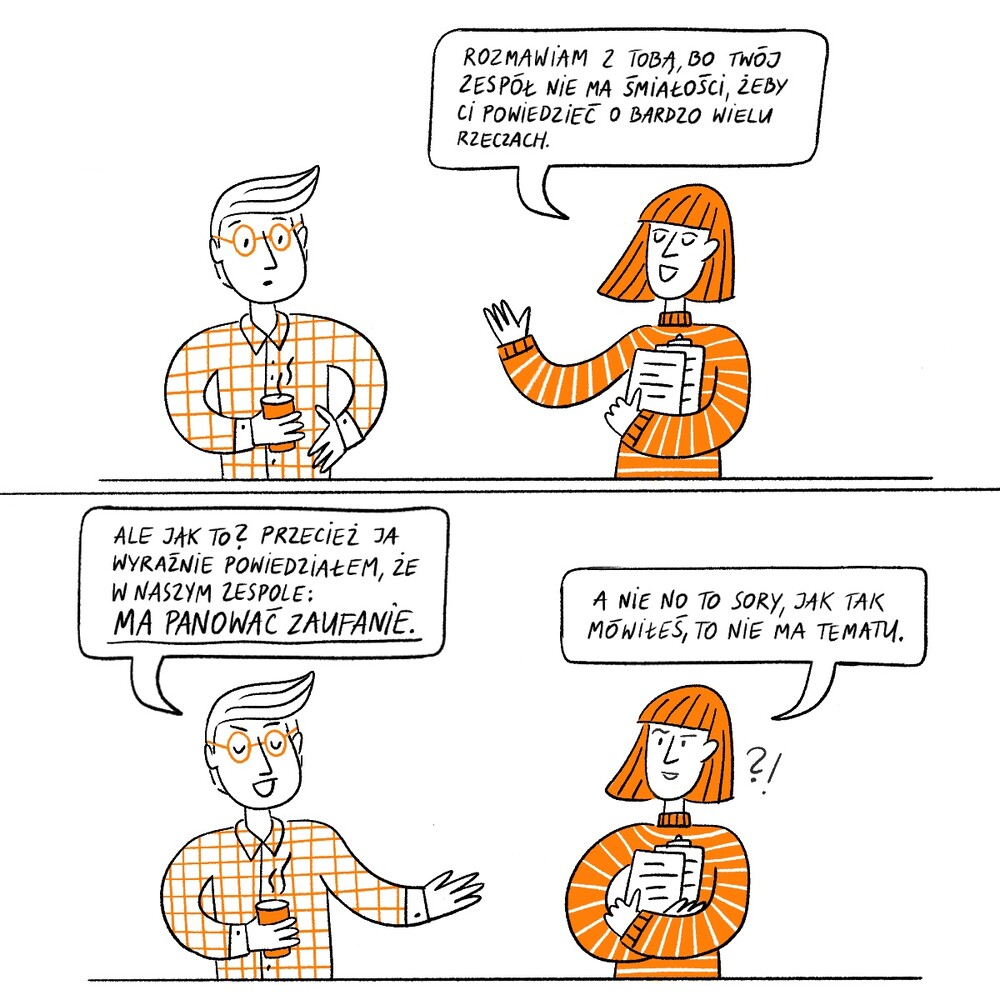
    A: A culture of safety is simply a situation where people enjoy working with each other, and at the same time, are not afraid to openly discuss problems and challenges. They support each other in solving them. This provides immense quality in collaboration.

    M: So, this lack of fear of open, sometimes uncomfortable conversations, is a litmus test? I feel safe enough to speak about difficult matters as well, because I know it won’t negatively impact my relationships with the team.

    A: Exactly. When I feel overwhelmed, I can raise my hand and say: “This is beyond me, I need support.” If this trust is absent, people grit their teeth and try to cope on their own at all costs. A team with trust discusses openly: what works, what doesn’t. Members help each other grow.

    M: So, a symptom of trust is openness to discussions about difficulties, and the absence of unofficial information flow. We talk during the meeting, not after it. And not about each other, but to each other. What else would you consider a sign that this trust exists or is absent?

    A: The courage to give and receive feedback. The ability to move beyond one’s ego. A mature organization is one where the leader can say: “I am not infallible; tell me if something isn’t working.” And the team speaks up. Hierarchy ceases to be a barrier.

    M: So there’s no “Mr. Director” – it’s just a conversation.

    A: Yes. In a healthy organization, people are not afraid to admit they don’t know something. They know they won’t be penalized for it. And as a result, they develop faster, collaborate better, and trust each other more. Feedback is not a threat, but a tool for a common goal.

    M: I imagine you’ve been in places where you joined an organization or a team and felt that it was already there. But there were probably places where you joined and it wasn’t. What then? If you were to give instructions to a leader joining a new organization – what should they do when they don’t see it or have doubts about its presence?

    A: There are various methods. One can do it oneself – in fact, it is every manager’s role to build this culture of trust within the team. One can also seek support – an external company, a consultant, a coach who guides the team towards such a stage. Lencioni provides ready-made solutions in his book. There are workshops described step-by-step: how to conduct them, how to build this culture of trust. However, I believe the leader is crucial here.

    M: My experience shows that joint workshops and meetings dedicated solely to this are crucial. These can be various types of activities. Certainly, an important stage is to ensure that team members get to know each other on a deeper level – that is, to create a situation where we see ourselves, with our different personality types, and discuss what is between us and what we want to agree upon in this regard. This won’t happen on its own during daily operational work – appropriate space must be created for it. And the question is, do I, as a leader, feel capable enough to model and lead such a meeting? It’s important to gauge your capabilities against your intentions – because sometimes it’s truly better to do it with the support of HR and an external company. Also, be prepared that not everyone will be enthusiastic about it from the start: “We have urgent work to do, and the boss came up with some psychological nonsense for us to do.”

    Another important element is also contracting – working on this at the beginning of collaboration. A leader’s initial address, so to speak: when I join a new team, I state what is important to me and what I will pay attention to.

    A: From my perspective, these are the first 3 to 6 months of work. This primarily involves conducting a team assessment of the team I’ve joined and observing how conversations unfold. Trust is very easy to recognize – at the first, or even better, meeting. Who speaks up, who doesn’t? Where does the “grey area” emerge? Who comes with questions through unofficial channels? Who wants to manipulate, who exerts influence, who makes subtle digs? All of this is very visible.

    M: So, let’s imagine you join such a team and start working with them. You observe and see that, for example, some people don’t speak up, some are reserved. What exactly do you do then? Do you talk individually or do you address the team and say: “Listen, I see something like this, and we need to change it?”

    A: First and foremost, I take notes and gather information: “Katarzyna doesn’t speak up. Piotr rolls his eyes. Paweł left the meeting – he disregarded the team.” I take notes, meaning I start to investigate and see a certain picture of the situation. Simultaneously, I ask questions and try to understand who is an introvert, who is an extrovert, for whom this is natural, and for whom it results from organizational culture or past events. The leader of a given team must start to see these matters from their own perspective and have their own assessment. Once they have an assessment, they can attempt to stimulate team members. Someone who doesn’t speak during a meeting might receive feedback in a one-on-one: “Listen, why don’t you speak up in meetings? You are an important team member. You should share your opinion – positive or negative. Your voice is important to me.”

    HOW TO PRACTICE THIS? HOW TO WORK ON THIS?

    1. Purchase the book “The Five Dysfunctions of a Team” You will find specific ways to work on them there – get inspired by the exercises from the book, check if you are ready to conduct some of them yourself.
    2. Organize team workshops, just remember to collaborate with a trainer or coach who has experience in these types of topics; discuss the goals, program, and your expectations with such a person. This workshop is too important; you need to be engaged in it.
    3. After the workshops, organize regular meetings with the team dedicated to building relationships and collaboration. These should not be operational meetings, but rather meetings titled: “What’s between us?” One of the elements of this type of meeting should be relational, integrative aspects, but any retrospective format can be used to analyze the last stage of collaboration, e.g., the last 3 months or a specific project. The retrospective format will guide you beautifully through this process; it’s only important to write down the conclusions and refer to them at the next meeting of this type.
    4. Watch Brene Brown’s speech “The Call to Courage” on Netflix.
    5. Send your team regular reinforcing messages with the message: “I want to hear you.” This is not something you say once and it’s done – it’s something you must consistently demonstrate through your actions every day, and also communicate clearly and frequently.
    6. Regularly ask:

    Remember and emphasize to the team that we discuss challenges and mistakes not to point them out, but to resolve them. Each of us has our strengths and areas for development. Repeat: “I want you to have the courage to speak openly – even when you disagree with me or see something I don’t perceive.”

    EXERCISE

    There is one exercise that works great in team workshops, and I’ve also heard from many managers that it was one of the exercises that worked well when they proposed it at a joint team meeting. This exercise can be preceded by taking a personality test and asking team members to include it in their discussion, but it is not necessary. It’s important to allow time for reflection and writing during the workshop itself, but also after the workshop.

    Instructions for the ‘My Strengths / My Weaknesses’ exercise:

    Ask everyone to first write down and then present to the group about themselves, considering the following points:

    My Strengths – What Strengths / Advantages

    What I bring to the team, what my talent is, what I enjoy, what comes easily to me. Where do I see my strengths, and what am I proud of, even if it’s not obvious or always very visible?

    • It’s important at this point not to be modest, but to assertively and confidently practice speaking about it subjectively.
    • Once a person has spoken, we ask other team members to add something to it. “Would you add anything to this? Is there anything that … didn’t mention but you appreciate? Is there anything else that inspires you, that is worth appreciating in … and how they work, even one small thing?”

    My Weaknesses – What Weaker Sides / What I Struggle With

    What might be difficult when collaborating with me, what I am working on, what I am aware of? What do I imagine might sometimes be a problem when collaborating with me? Where do I need your tolerance?

    • At this point, the rest of the team adds nothing. The goal of this exercise is not mutual feedback, but rather wise self-disclosure and working towards mutual understanding and comprehension, as well as building trust. Here, everyone gives feedback to themselves, not to each other, and only the point above is an exception because it focuses on strengths.

    What, then, Do I Need from the Team to Function Well within it? What is Important and Necessary for Me?

    What is particularly important for me in the context of, for example: communication style, responsiveness, communication channels, working under pressure, and high multi-tasking, etc.

    • We can, for example, collect the conclusions from the last point on a flipchart or in a document.

    REMEMBER:

    • Trust is born when, in addition to ongoing collaboration:
    • we get to know each other more deeply on various levels (integration, informal meetings, joint activities, workshops)
    • we talk about what is important
    • we talk about what is between us
    • we talk about our needs and expectations