

There may be a structure, roles, and KPIs, but there will be no authentic cooperation, accountability, or growth. In this chapter, we discuss what psychological safety is, how to build it – and why it’s worthwhile. Because it all starts here.
SELF-ASSESSMENT / REFLECTION EXERCISE
Think about the last one or two team meetings.
- Did everyone freely express their opinions, even if they differed from the rest?
- Did anyone admit to a mistake or openly ask for help?
- When was the last time you asked someone on the team how they were feeling – not just professionally, but personally?
- Has it ever happened that someone remained silent, even though you know they had something to say?
Now, think about yourself as a leader:
- How do you react when someone reports a problem or an error? Does your initial reaction create space for people to be open, or does it rather make them hesitate next time?
- How often do you admit to the team that you don’t know something, that you are wrong, or that you need help?
- What signals do you send – consciously or unconsciously – about whether your team members can be their full selves?
Write down one thing you can do today to strengthen psychological safety in your team. It could be a small gesture, a question, or a specific change in how conversations are conducted.
What can you do? When and in what situation?
Chapter: It Starts with Trust
M: For many of the topics we discuss in this book to be understandable, we first need to clarify what we mean by a culture of safety and trust – because everything begins with it. Psychological safety is the foundation for topics concerning feedback, types of meetings, and all difficult conversations. We agreed not to rewrite other books, so we immediately refer our readers to Lencioni’s “The Five Dysfunctions of a Team.” But for those who haven’t read it or for whom it might take a while – how would we define this foundation? How to build trust, how does it manifest?
A: A culture of safety is simply a situation where people enjoy working with each other, and at the same time, are not afraid to openly discuss problems and challenges. They support each other in solving them. This provides immense quality in collaboration.
M: So, this lack of fear of open, sometimes uncomfortable conversations, is a litmus test? I feel safe enough to speak about difficult matters as well, because I know it won’t negatively impact my relationships with the team.
A: Exactly. When I feel overwhelmed, I can raise my hand and say: “This is beyond me, I need support.” If this trust is absent, people grit their teeth and try to cope on their own at all costs. A team with trust discusses openly: what works, what doesn’t. Members help each other grow.
M: So, a symptom of trust is openness to discussions about difficulties, and the absence of unofficial information flow. We talk during the meeting, not after it. And not about each other, but to each other. What else would you consider a sign that this trust exists or is absent?
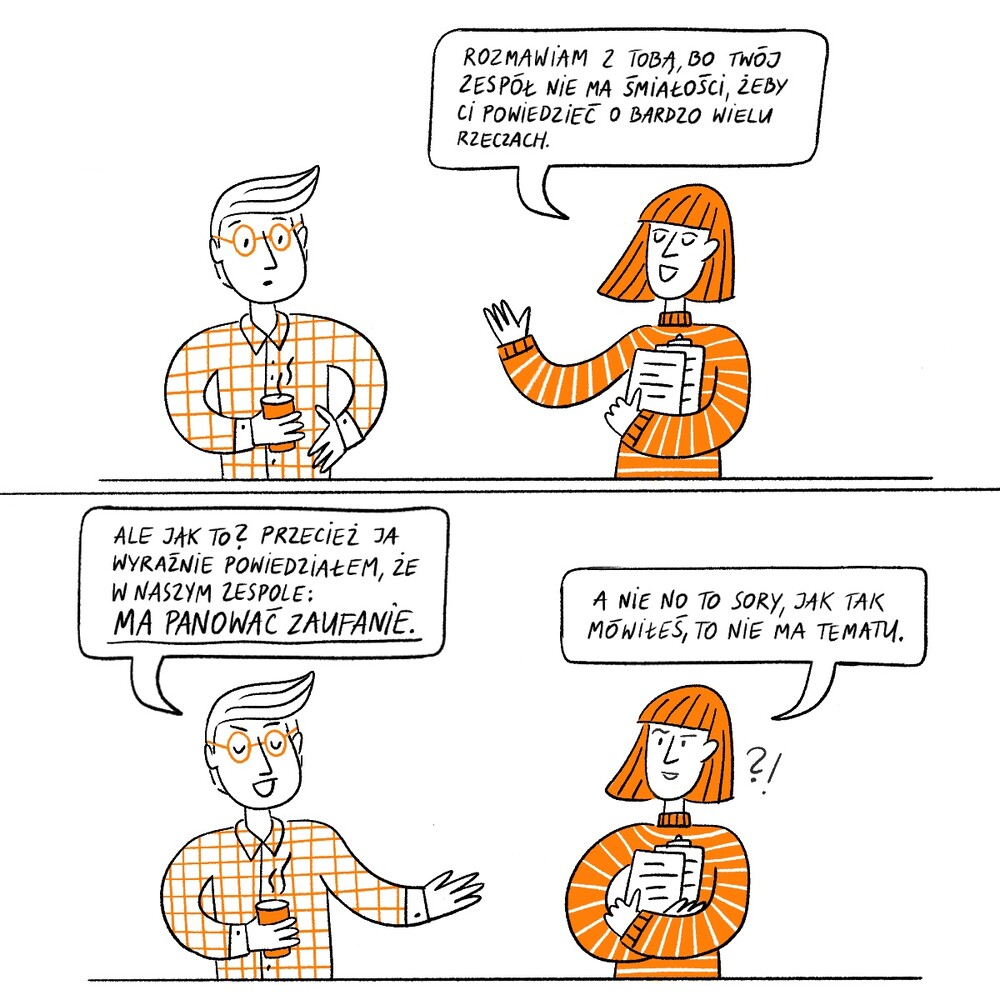
A: The courage to give and receive feedback. The ability to move beyond one’s ego. A mature organization is one where the leader can say: “I am not infallible; tell me if something isn’t working.” And the team speaks up. Hierarchy ceases to be a barrier.
M: So there’s no “Mr. Director” – it’s just a conversation.
A: Yes. In a healthy organization, people are not afraid to admit they don’t know something. They know they won’t be penalized for it. And as a result, they develop faster, collaborate better, and trust each other more. Feedback is not a threat, but a tool for a common goal.
M: I imagine you’ve been in places where you joined an organization or a team and felt that it was already there. But there were probably places where you joined and it wasn’t. What then? If you were to give instructions to a leader joining a new organization – what should they do when they don’t see it or have doubts about its presence?
A: There are various methods. One can do it oneself – in fact, it is every manager’s role to build this culture of trust within the team. One can also seek support – an external company, a consultant, a coach who guides the team towards such a stage. Lencioni provides ready-made solutions in his book. There are workshops described step-by-step: how to conduct them, how to build this culture of trust. However, I believe the leader is crucial here.
M: My experience shows that joint workshops and meetings dedicated solely to this are crucial. These can be various types of activities. Certainly, an important stage is to ensure that team members get to know each other on a deeper level – that is, to create a situation where we see ourselves, with our different personality types, and discuss what is between us and what we want to agree upon in this regard. This won’t happen on its own during daily operational work – appropriate space must be created for it. And the question is, do I, as a leader, feel capable enough to model and lead such a meeting? It’s important to gauge your capabilities against your intentions – because sometimes it’s truly better to do it with the support of HR and an external company. Also, be prepared that not everyone will be enthusiastic about it from the start: “We have urgent work to do, and the boss came up with some psychological nonsense for us to do.”
Another important element is also contracting – working on this at the beginning of collaboration. A leader’s initial address, so to speak: when I join a new team, I state what is important to me and what I will pay attention to.
A: From my perspective, these are the first 3 to 6 months of work. This primarily involves conducting a team assessment of the team I’ve joined and observing how conversations unfold. Trust is very easy to recognize – at the first, or even better, meeting. Who speaks up, who doesn’t? Where does the “grey area” emerge? Who comes with questions through unofficial channels? Who wants to manipulate, who exerts influence, who makes subtle digs? All of this is very visible.
M: So, let’s imagine you join such a team and start working with them. You observe and see that, for example, some people don’t speak up, some are reserved. What exactly do you do then? Do you talk individually or do you address the team and say: “Listen, I see something like this, and we need to change it?”
A: First and foremost, I take notes and gather information: “Katarzyna doesn’t speak up. Piotr rolls his eyes. Paweł left the meeting – he disregarded the team.” I take notes, meaning I start to investigate and see a certain picture of the situation. Simultaneously, I ask questions and try to understand who is an introvert, who is an extrovert, for whom this is natural, and for whom it results from organizational culture or past events. The leader of a given team must start to see these matters from their own perspective and have their own assessment. Once they have an assessment, they can attempt to stimulate team members. Someone who doesn’t speak during a meeting might receive feedback in a one-on-one: “Listen, why don’t you speak up in meetings? You are an important team member. You should share your opinion – positive or negative. Your voice is important to me.”
HOW TO PRACTICE THIS? HOW TO WORK ON THIS?
- Purchase the book “The Five Dysfunctions of a Team” You will find specific ways to work on them there – get inspired by the exercises from the book, check if you are ready to conduct some of them yourself.
- Organize team workshops, just remember to collaborate with a trainer or coach who has experience in these types of topics; discuss the goals, program, and your expectations with such a person. This workshop is too important; you need to be engaged in it.
- After the workshops, organize regular meetings with the team dedicated to building relationships and collaboration. These should not be operational meetings, but rather meetings titled: “What’s between us?” One of the elements of this type of meeting should be relational, integrative aspects, but any retrospective format can be used to analyze the last stage of collaboration, e.g., the last 3 months or a specific project. The retrospective format will guide you beautifully through this process; it’s only important to write down the conclusions and refer to them at the next meeting of this type.
- Watch Brene Brown’s speech “The Call to Courage” on Netflix.
- Send your team regular reinforcing messages with the message: “I want to hear you.” This is not something you say once and it’s done – it’s something you must consistently demonstrate through your actions every day, and also communicate clearly and frequently.
- Regularly ask:
Remember and emphasize to the team that we discuss challenges and mistakes not to point them out, but to resolve them. Each of us has our strengths and areas for development. Repeat: “I want you to have the courage to speak openly – even when you disagree with me or see something I don’t perceive.”
EXERCISE
There is one exercise that works great in team workshops, and I’ve also heard from many managers that it was one of the exercises that worked well when they proposed it at a joint team meeting. This exercise can be preceded by taking a personality test and asking team members to include it in their discussion, but it is not necessary. It’s important to allow time for reflection and writing during the workshop itself, but also after the workshop.
Instructions for the ‘My Strengths / My Weaknesses’ exercise:
Ask everyone to first write down and then present to the group about themselves, considering the following points:
My Strengths – What Strengths / Advantages
What I bring to the team, what my talent is, what I enjoy, what comes easily to me. Where do I see my strengths, and what am I proud of, even if it’s not obvious or always very visible?
- It’s important at this point not to be modest, but to assertively and confidently practice speaking about it subjectively.
- Once a person has spoken, we ask other team members to add something to it. “Would you add anything to this? Is there anything that … didn’t mention but you appreciate? Is there anything else that inspires you, that is worth appreciating in … and how they work, even one small thing?”
My Weaknesses – What Weaker Sides / What I Struggle With
What might be difficult when collaborating with me, what I am working on, what I am aware of? What do I imagine might sometimes be a problem when collaborating with me? Where do I need your tolerance?
- At this point, the rest of the team adds nothing. The goal of this exercise is not mutual feedback, but rather wise self-disclosure and working towards mutual understanding and comprehension, as well as building trust. Here, everyone gives feedback to themselves, not to each other, and only the point above is an exception because it focuses on strengths.
What, then, Do I Need from the Team to Function Well within it? What is Important and Necessary for Me?
What is particularly important for me in the context of, for example: communication style, responsiveness, communication channels, working under pressure, and high multi-tasking, etc.
- We can, for example, collect the conclusions from the last point on a flipchart or in a document.
REMEMBER:
- Trust is born when, in addition to ongoing collaboration:
- we get to know each other more deeply on various levels (integration, informal meetings, joint activities, workshops)
- we talk about what is important
- we talk about what is between us
- we talk about our needs and expectations